|

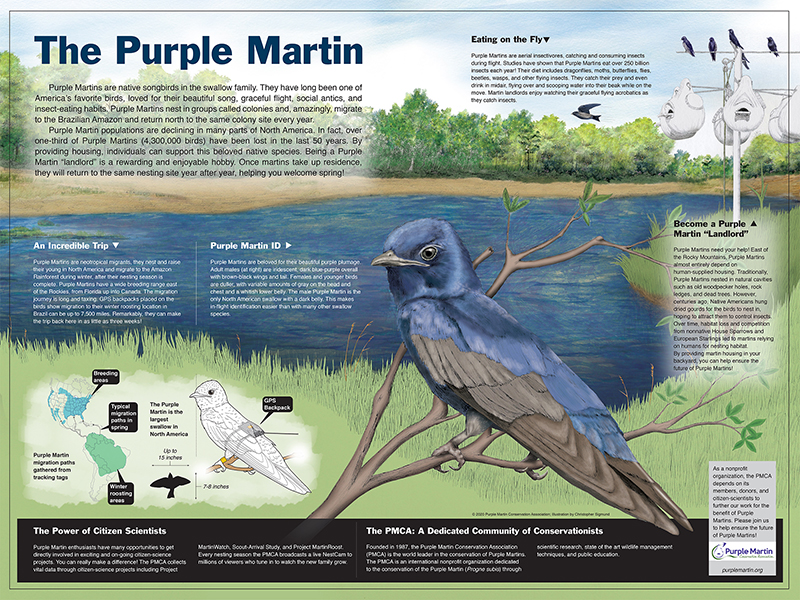
The Purple Martin is an American treasure!A rural martin house or gourd rack with an active colony is almost as American as baseball and apple pie. Interest in Purple Martins dates back to the days before Europeans set foot on the North American continent. Native Americans were already providing homes for Purple Martins in the form of calabash gourds when Europeans first laid eyes on this graceful member of the swallow family. It is believed that the Native Americans had learned that martins would attack birds of prey and crows that would attempt to eat meat drying on racks in the open and unguarded crops. Or, perhaps they just enjoyed having the martins around like many of us do today. As any martin landlord can tell you, hosting a colony of Purple Martins somehow transgresses the physical and enters the psychological realm of gratification.
A notable change has occurred over time regarding the Purple Martin’s breeding habits in the eastern half of the continent where the nominate race, Progne subis subis, nests. In this area of the country, martins are almost totally dependent upon human supplied martin housing. This means that martins in the eastern half of the country must have our help every year to ensure that they have adequate housing in which they can successfully rear their young. Martins of the subspecies Progne subis hesperia, which are found in the Desert Southwest, still use natural nesting sites such as cavities in Saguaro cacti. Martins of the subspecies Progne subis arboricola, which are found in the Pacific Northwest and Rocky Mountains, still mainly use natural cavities, such as abandoned woodpecker holes, but have recently begun nesting in single unit martin houses and gourds near bodies of water. (Refer to the Range Map below for complete descriptions of the different Purple Martin subspecies)
| DESCRIPTION |
| The Purple Martin (Progne subis) is the largest North American representative of the swallow family (Hirundinidae). The Progne genus of the swallow family encompasses several species of large, New World martins including our own Purple Martin. When people envision a Purple Martin, they usually think of the mature male which appears black overall. His body feathers have a steel blue iridescence which can look purple under certain lighting conditions, especially right after a heavy late evening rain storm. His tail and wing feathers are duller in coloring and do not have the iridescence of his body feathers. Martins are the only North American swallow species that are sexually dimorphic, meaning that the mature male and female are colored differently. The mature female is more subdued in her coloring, being predominately grayish all over with some steel blue coloring mixed in. Subadult martins (those that hatched the previous year), while sexually mature, are colored differently than the adults. Please refer to the excellent plumage photo series below by James R. Hill, III of the PMCA and following that is his complete description of Purple Martin plumages by age. |
| PLUMAGE DESCRIPTIONS (by James R. Hill, III) |
Adult Male: The adult male Purple Martin is entirely glossy purple-black (or steel-blue) and is the easiest of the five sex/age classes to distinguish. They are unmistakable in appearance and give the species its name. Male martins do not acquire this plumage until their 3rd calendar year of life. In other words, a male martin hatched last summer, in 1997, will not have the characteristic, all purple-black plumage until next summer, in 1999, (e.g. 1997=1st calendar year, 1998=2nd calendar year, and 1999=the 3rd calendar year). Male martins molt into this plumage during their second "wintering" stay in Brazil.
Subadult Male: The subadult male Purple Martin is often mistaken for a female by the novice landlord. Subadult males differ, however, from all females by some subtle plumage differences; differences that can be difficult to see without a good pair of binoculars or spotting scope. First of all, subadult males have a sprinkling of at least one, but usually many, solid purple feathers in one or all of the following areas: their chins, throats, breasts, flanks, bellies, or undertail coverts (crissum). The number of purple feathers in these areas is highly variable. Some individuals may only have one, tiny, purple feather in just one of these areas. Others have so many that they are almost half-purple on front. Subadult males also have stronger and more extensive purple on their crowns and cheeks than females do. In addition, subadult males usually have a scattering of isolated purple feathering on their napes (hind neck), backs, and rumps.
Subadult Female: In Spring and early Summer, subadult females are easy to distinguish from adult females because of the weak purple to brownish color of their upper surface (i.e., back side) plumage as compared to the much brighter purple of the adult females. However, as the season advances and the feathers of adult females become worn and sun bleached, it can be a bit more difficult, on some individuals, to distinguish these two female age classes using back color alone. An alternative method is to compare the colors of the undertail coverts. The undertail coverts of adult females are usually quite dusky all over the individual feather vanes. In contrast, the undertail coverts of subadult females are usually pure white or faintly dusky, with only the central quill a darker color. One caution, however, there is a lot of variation in crissum color and this field mark should be used in conjunction with back color. And finally, subadult females are also usually slightly lighter on their breasts and bellies than are adult females, which tend to be duskier in these areas.
Adult Female: Adult females are far more purple on their crown, nape, shoulders, back, and rump than are subadult females, which tend to be far browner in these areas. In addition, adult females tend to have slightly darker breasts, bellies, and undertail coverts (i.e., crissums) than do subadult females.
Juvenile: The hatching year (i.e., juvenal) plumage of martins resembles that of the subadult female, but generally has a more washed-out, brownish to watery, blue-green back color than the more strongly colored, older subadults, plus they have a cleaner, newer-plumaged look to them. The tails of juveniles average slightly shorter than older birds. |
Nominate Race: Progne subis subis - is the familiar martin in the eastern half of the continent. It is midway in size between the other two subspecies. Males are identical to their subspecies counterparts; however, females are darker underneath appearing more gray than the western subspecies females.
Subspecies: Progne subis hesperia - is the martin of the desert southwest. This is the smallest of the three subspecies and nests in cavities of the Saguaro cacti. Females are much paler than subis on the forehead and underparts.
Subspecies: Progne subis arboricola - is the martin of the Rocky Mountains and Pacific Northwest. This is the largest of the three subspecies and females are also lighter on the forehead and underparts than the nominate race subis.
Subspecies: Progne subis subis (suggested) - in the mountains of northern and southeastern Arizona there are martins that are too small to be P.s.arboricola, too large to be P.s.hesperia and, although the exact same size as the nominate race P.s.subis, their vocalizations are more similar to P.s.hesperia. Personally, I feel that over time there may have been breeding between small pockets of P.s.arboricola from the southern Rocky mountain areas, and the desert race of P.s.hesperia in areas where desert and montane habitats occur within the same geographic area, thus producing offspring which are the same size as P.s.subis and yet are not truly of that race. Most martin authorities today recognize these martins as belonging to P.s.subis. |
| AVERAGE VITAL STATISTICS FOR PURPLE MARTINS, BY SUBSPECIES: |
Race: subis
Weight: 48-61 grams (mean 55)
Length: 7½"
Wingspan: 134-152 mm (male)
Wingspan: 136-146 mm (female) |
Race: hesperia
Weight: 40-52 grams (mean 46)
Length: 7"- 7½"
Wingspan: 132-147 mm (male)
Wingspan: 132-140 mm (female) |
Race: arboricola
Weight: 53-64 grams (mean 59)
Length: 7½" - 8"
Wingspan: 146-157 mm (male)
Wingspan: 141-154 mm (female) |
| DIET AND FEEDING BEHAVIOR |
| Stomach analysis of martins reveal that adults eat mainly Hymenoptera (approximately 25% of the diet), especially winged ants and wasps but also some drone bees. Martins also relish winged termites and seek swarms of them in the Spring. They also frequently consume flies, bugs, beetles, moths and butterflies, and one of their favorite summer foods is the dragonfly. Other items that appear occasionally in the diet include spiders, mayflies, damselflies, grasshoppers, beetles, and yes - a few mosquitoes (see below). |
| HUNTING TECHNIQUES: |
Martins hunt in loose groups where there is available prey. They hunt more as individuals or mated pairs than more colonial species such as the Cliff Swallow (Hirundo pyrrhonota). There are basically two methods of hunting: 1) Slow gliding in circles on outstretched wings interspersed with a few quick wing beats. Small insects that swarm (termites, ants) and/or are weak fliers are taken by this method. 2) Seeking out large individual insects such as dragonflies and actively pursuing them with swift, powered flight. Dragonflies have been recorded flying over 30 mph and, therefore, martins must use their tremendous flying ability to capture them on a consistent basis. |
| ARE PURPLE MARTINS MOSQUITO EATING MACHINES? |
| Hardly. One of the Purple Martin’s favorite foods in the summer months is the dragonfly. These large insects provide a substantial meal to the hungry martin nestlings and are worth the martin’s effort in capturing them. Dragonflies are swift fliers, but a colony of martins captures hundreds of them throughout the summer when feeding their young. Ironically, the dragonfly is one of the greatest predators of mosquitoes so, in effect, the more dragonflies that are captured by martins, the more mosquitoes that will live to bite another day. To put it another way, recent studies have shown that mosquitoes comprise only about 3% of an adult martin’s diet (PMCA research). Why don’t martins eat more mosquitoes? There are several reasons which are actually quite simple when you think about them: |
- Martins are very large swallows and can weigh up to 60 grams. The energy expended in capturing a single large insect like a dragonfly is minimal compared with the energy it would require to capture the hundreds of mosquitoes that would equal the same amount of food as the single dragonfly. Therefore, it is in the martin’s best interest for survival to target larger prey items than mosquitoes.
- Martins are diurnal hunters, meaning that they hunt during the daylight hours. Mosquitoes are mainly nocturnal, or nighttime hunters, meaning that they are usually just coming out to bite when the martins are coming in to roost for the night.
- Martins and mosquitoes seldom come into contact with each other. Martins feed quite high in the air and mosquitoes typically stay close to the ground.
- Martins, being strong fliers, typically hunt far away from their colony site. This means that all of the mosquitoes on your property where your martin housing is located are virtually untouched by your martins when they are away hunting.
|
| In summary, if you purchase martin housing hoping that they will control mosquitoes, you’re wasting your money. How do I know this? Experience. If you need proof, you’re welcome to come and visit me sometime and we can sit out together and watch my large colony of martins in the evening. However, if we don’t spray from head to toe with insect repellent we will be eaten alive! |
| LIFE SPAN AND YEARLY SURVIVAL RATES |
Most martins probably live only 2-5 years with exceptional adults living 6-7 years or more. The oldest banded martin was almost 14 years old and there would almost certainly have been individuals that have lived longer than this in the wild.
Oldest Martin On Record
Oldest official record involves a male martin carrying U.S. bird band #B261331. He was banded July 1, 1933 in Dallas City, Illinois and was found dead under a martin house in Dallas City in the Spring of 1947 - 13 years and 10 months later.
Yearly Mortality
Studies have shown that the annual mortality rate of adult martins is approximately 50% and even higher for juveniles (martins that hatched and fledged that year). Approximately 65-75% of martins that successfully fledge in a given season won’t survive to return the following year (see causes of mortality below). |
| MORTALITY AND ITS CAUSES |
The major causes of mortality for martins are the weather and to a lesser degree, predators. Below are descriptions of weather conditions that are unfavorable to martins and then an introduction to martin predators. Refer to the colony management and predators sections for more detailed information.
Inclement Weather
Inclement weather is probably the single greatest threat to the survival of Purple Martins range-wide and certainly contributes to their high annual mortality rates. Inclement weather conditions not only involve cold and wet weather, but also very hot and dry conditions. Both cold/wet and hot/dry conditions are detrimental to the survival of the martin’s flying insect prey. Because martins are aerial insectivores, meaning that they subsist almost entirely on flying insects, they must have a readily available supply of flying insects or they will starve. While martins can be trained to accept meal worms and other foods from feeding trays during inclement weather conditions, this is not natural behavior for them. Martins can usually survive for 3-4 days without eating but will then rapidly weaken and die if they are unable to obtain food after that time.
Cold / Wet weather is the worst condition for martins to survive because flying insects typically become inactive when the temperature drops below 48º F which completely cuts off their food supply. Martins are also highly susceptible to hypothermia, or abnormally low body temperatures, and may die of exposure after several days of extremely cold weather. Martins try to conserve body heat by clustering together in a single cavity or two and remaining inactive. This helps them to conserve their energy which is vital for their survival during these times of severe cold. Martins on the interior of this cluster are more likely to survive than the ones on the outside which may still succumb to exposure (refer to the Colony Management section for ways that you can help your martins during periods of severe cold).
Hot / Dry weather with long periods of drought are also detrimental to your martins. Long periods of intense heat without rain lead to fewer hatches of insects. During these times, if insects are in very limited supply, the adult martins will feed themselves first and the nestlings may starve. This may sound selfish of the adult martins, but this is nature’s way of increasing the odds that the adults will survive to return and try to raise young again the following year.
Predators
There are several predators of adult martins including ones that climb poles such as rat snakes and raccoons and others such as house cats that will pounce on martins as they land on the ground to collect nesting material, grit, etc. There are also aerial predators that may attempt to capture martins in the air (accipiter hawks & falcons) or by extracting martins, both adults and young, from their nesting compartments (owls, crows, gulls and jays). Predators are usually more of a local problem than inclement weather, which can affect an entire region, and most types of predation can be controlled or limited (see the Predators section for a complete list of martin predators. Also, refer to the Colony Management section for management techniques that will allow you to limit predation at your colony site). |
Back to Archives
|